

Are you looking to grow your money significantly over the next 5 years? Whether you’re saving for a dream vacation, a down payment on a house, your child’s higher education, or want to build a solid wealth corpus, a 5-year horizon gives you a sweet spot — long enough for compounding to work its magic, yet short enough to stay realistic about risks.
In this post, I’ll break down the best investment plans for 5 years that offer the potential for high returns, while keeping things practical, honest, and beginner-friendly. Let’s dive in!
Why a 5-Year Investment Horizon is Special
5 years is considered a medium-term horizon in investing.
- It’s long enough for equity markets to recover from short-term volatility.
- Short enough that you don’t want to take extremely high risks (like putting everything in small-cap stocks or speculative crypto).
Historically, equity-oriented investments in India have delivered 12–18%+ annualized returns over 5-year periods (though past performance is never a guarantee). On the safer side, fixed-income options give 6–8% with almost zero risk to your capital.
The golden rule: Higher potential returns = Higher risk. The best plan depends on your risk appetite, monthly savings capacity, and financial goals.
Top Investment Options for 5 Years with High Return Potential
Here’s a clear breakdown of the best choices in 2026:
1. Equity Mutual Funds (Especially via SIP) – Best for High Returns
This is often the top recommendation for most people aiming for high returns over 5 years.
- Why it works: Equity funds (large-cap, flexi-cap, mid-cap) invest in growing Indian companies. With systematic investment plans (SIPs), you benefit from rupee-cost averaging and compounding.
- Expected Returns: 12–18% annualized (can be higher in good market cycles, lower in bad ones).
Best Categories:
- Flexi Cap / Multi Cap Funds (balanced growth)
- Large & Mid Cap Funds
- Index Funds (Nifty 50 or Nifty Next 50) – low cost and simple
- Who should choose this? People with moderate to high risk tolerance who can stay invested even if markets fall temporarily.
Pro Tip: Start a monthly SIP of ₹5,000–₹20,000 in 2–3 well-diversified equity funds. Many investors have turned ₹3–5 lakh invested over 5 years into ₹6–10 lakh+ through disciplined SIPs.
2. Hybrid / Balanced Advantage Funds
Want high returns but with a safety net?
These funds invest partly in equity (for growth) and partly in debt (for stability). They usually deliver 10–14% returns with lower volatility than pure equity funds. Great for first-time equity investors.
3. ELSS Mutual Funds (Tax-Saving + Growth)
If you want to save tax under Section 80C while aiming for high returns:
- 3-year lock-in (perfect for 5-year horizon)
- Equity-focused, so high return potential (historically 14–16%+ over 5 years)
- Ideal if you’re in the higher tax bracket.
4. Real Estate / REITs (For Diversification)
- Direct property buying needs huge capital and has liquidity issues.
- REITs (Real Estate Investment Trusts) let you invest in commercial/real estate with as little as ₹10,000–₹15,000. They offer rental income + property appreciation.
- Expected returns: 10–14% (combination of dividends + capital growth).
5. Gold (Digital Gold / Sovereign Gold Bonds / Gold ETFs)
Gold acts as a hedge against inflation and market crashes. Over 5 years, it has given decent returns during uncertain times. Not the highest return option, but excellent for portfolio diversification.
6. Fixed Income Options (For Conservative Investors)
- 5-Year Bank/Post Office FDs or Tax-Saver FDs → 6–7.5% returns (safe but lower growth)
- National Savings Certificate (NSC) → Around 7.7% with tax benefits
- Corporate Bonds or Debt Funds → Slightly higher than FDs with moderate risk
These are best if capital protection is more important than high returns.
Sample 5-Year Investment Strategy (Practical Example)
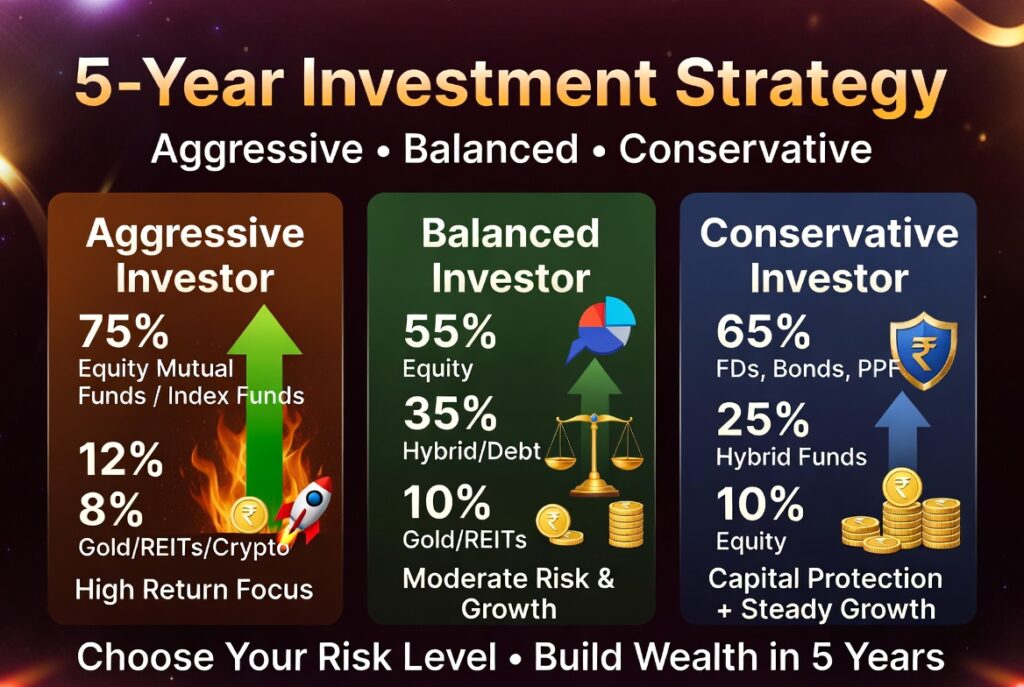
Aggressive Investor (High Return Focus):
- 70–80% in Equity Mutual Funds / Index Funds
- 10–15% in Hybrid Funds
- 5–10% in Gold / REITs / Crypto (small portion)
Balanced Investor:
- 50–60% Equity
- 30–40% Hybrid / Debt
- 10% Gold / REITs
Conservative Investor:
- 60–70% in FDs, Bonds, PPF
- 20–30% in Hybrid Funds
- 10% Equity for some growth
| Where to Invest Money to Get Good Returns: A Simple, Practical Guide for Every Stage of Life | Small Business Idea That Makes $500 Every Day (Beginner Friendly Guide) |
|---|
Power of Compounding Example:
Investing ₹10,000 per month for 5 years at 14% average return could grow to approximately ₹8–9 lakhs (your total investment = ₹6 lakhs). At 12%, it would be around ₹7.8 lakhs. A small difference in returns creates a big gap!
Important Things to Keep in Mind
- Diversify — Never put all your money in one asset.
- Stay Disciplined — SIPs work best when continued even during market corrections.
- Review Annually — Rebalance your portfolio once a year.
- Inflation — Anything below 7–8% may not beat rising costs in the long run.
- Taxes — Equity investments held over 1 year attract LTCG tax (above ₹1.25 lakh gains). Debt has different rules.
Final Thoughts: There’s No “One Best” Plan
The best investment plan for 5 years with high returns is the one that matches your risk profile and that you can stick with comfortably.
For most young and middle-aged investors in India today, a disciplined SIP in diversified equity mutual funds or index funds offers the best combination of high return potential and simplicity.
Start small if you’re nervous. Even ₹2,000–₹5,000 per month can make a meaningful difference over 5 years.
What’s your goal for the next 5 years? Are you more comfortable with equity, or do you prefer safer options? Share in the comments — I’d love to help you refine your plan!
Disclaimer: This article is for educational and informational purposes only. It is not personalized financial advice. Investing in mutual funds, stocks, or any market-linked product involves risk, including the risk of loss of capital. Past performance does not guarantee future results. Please consult a certified financial advisor before making any investment decisions based on your individual financial situation, goals, and risk tolerance. Only invest money you can afford to keep locked for the intended period.